We may earn a commission when you buy through links on this page, at no extra cost to you. How this works.
High-energy cats need consistent outlets for their hunting instinct, especially when you're not home to wave a wand toy. Automated laser toys promise hands-free exercise, but the market splits into categories that matter more than brand loyalty: ceiling-mounted units that sweep wide arcs, tabletop models that stay put, battery-powered portables you can relocate, and USB-rechargeable designs with programmable timers.
The right choice depends on whether your cat sprints in open loops, prefers vertical wall chases, or shares the space with other pets who might knock a lightweight unit across the floor. Noise level becomes critical in apartments or if the toy runs while you sleep. Battery life determines whether you'll recharge weekly or swap AAs every month.
These devices create structured solo play windows - they are not replacements for the interactive sessions where you read your cat's energy and adjust pace. Guilt over long work hours is common, but a laser toy running two fifteen-minute cycles a day offers predictable stimulation without the risk of boredom that comes from leaving it on continuously. The goal is to match the tool's trajectory pattern and runtime to your cat's actual behavior, not to buy the most features and hope they all get used.
This guide compares four models on the variables that change how a cat engages: the randomness of the laser path, how securely the unit mounts, whether the motor hum registers above ambient room noise, and how often you'll need to intervene for power. By the end, you'll know which constraints matter for your floor plan and which features your cat will actually notice.
Quick comparison
| Saolife Automatic Laser Cat Toy with Random Trajectory, Suction Cup Design, Quiet | Check current price and suction-cup reviews |
| Sofolor Automatic Laser Cat Toy with Random Trajectory, Suction Cup, Quiet, USB Rechargeable | Compare suction strength and battery life |
| umosis Automatic Interactive Cat Laser Toy | See footprint dimensions and setup options |
Use the matching tool first
Start with Smart Feeder Portion Calculator if you want to narrow the fit before checking current offers.
Why High-Energy Cats Benefit from Automated Laser Play
Cats bred for hunting or with naturally high prey drive often pace, vocalize, or engage in destructive scratching when their energy has no outlet. Automated laser toys deliver short bursts of high-speed chase that mirror the stalk-and-sprint rhythm of wild hunting, giving these cats a structured way to burn calories and focus attention when you're at work or asleep.
Laser dots trigger the same neural pathways as live prey movement, which makes the chase irresistible but leaves no tangible catch at the end. Without that finish, some cats grow frustrated or restless after repeated sessions. Pairing each automated session with a small treat or a plush toy they can pounce immediately afterward gives them the reward closure their instincts expect and helps maintain interest over weeks of use.
Consistency matters more than duration for high-energy cats. A fifteen-minute session at the same time each evening becomes a reliable ritual, reducing anxiety and boredom during long office days or when you travel. Automated models run on timers and require no manual aiming, so the play happens whether you're home or not, keeping routines intact and energy levels manageable.
Safety Considerations: What Every Laser Toy Owner Must Know
Class II lasers - the classification used in most automated cat toys - emit low-power visible light, but direct eye exposure can still cause discomfort or temporary vision disturbances. Never aim the beam toward your cat's face, and position the toy so the laser projects horizontally or downward rather than at eye level during operation.
Supervise the first few sessions to observe how your cat reacts. Some cats sprint and leap enthusiastically, while others freeze or lose interest after a few minutes. If your cat seems confused, anxious, or overly fixated after the toy stops, the lack of a physical reward may be the issue.
Always end laser play with something tangible. Toss a crinkle ball, offer a feather wand for a quick capture, or drop a treat on the floor where the laser last appeared. This closure helps satisfy the predatory sequence and reduces post-play frustration.
For cats that circle the room looking for the vanished dot, consider pairing laser sessions with puzzle feeders or treat-dispensing balls. The combination keeps energy high but adds a concrete payoff, balancing the mental loop that laser-only play can create.
How to Introduce an Automated Laser Toy to Your Cat
Start the first session with a short five-minute cycle to gauge your cat's interest without overwhelming her. Place the automated laser toy at or below your cat's eye level - on the floor, a low coffee table, or shelf - so the dot projects naturally across the ground or nearby walls where she can chase it comfortably.
Watch how your cat responds. Some high-energy cats pounce immediately, while others take a few seconds to notice the moving dot. If your cat ignores the laser or walks away after a minute, try running the toy at different times of day when her energy typically peaks - early morning or just before dinner often work well.
If your cat becomes fixated and won't stop staring at the toy even after it shuts off, limit sessions to twice daily and always end each cycle by tossing a small treat or interactive toy she can physically catch. This gives her a tangible reward and helps prevent frustration from chasing something she can never hold.
Keep early sessions brief and adjust the schedule based on how she engages, building up duration only once she shows consistent interest without signs of stress or obsession.
When to Skip Automated Laser Toys Altogether
Automated laser toys work well for many high-energy cats, but they aren't the right fit for every animal. Some cats lose interest quickly when they can't physically catch the target, while others become fixated or show signs of frustration after repeated sessions that never end with a tangible reward.
Watch for pacing, excessive vocalization, or compulsive searching behavior after the laser shuts off. These signals suggest your cat may need toys that offer closure - something they can grab, bite, or bat around. Feather wands, motorized mice with real fur textures, and treat-dispensing puzzle balls give cats the satisfaction of a successful hunt.
Cats driven by scent rather than motion often ignore laser dots entirely and prefer catnip-stuffed kickers or crinkle tunnels. Vertical climbers and scratchers satisfy cats who channel energy into jumping and clawing rather than chasing.
If your cat enjoys laser play but becomes overstimulated, limit sessions to five minutes and immediately follow up with a physical toy or a small treat to provide a sense of completion. Rotate laser play with other enrichment types throughout the week rather than relying on it daily. Laser toys function best as one element in a varied routine, not as a replacement for hands-on interaction or prey-like objects your cat can capture.
Final Verdict: Match the Toy to Your Space and Schedule
All four automated laser toys reviewed here sell for $19.99 and carry similar owner ratings, which means your decision comes down to room layout, surface type, and how you want the toy to start. The Saolife model works best in quiet, smooth-surface homes where you can mount it high and let scheduled intervals keep your cat engaged without manual restarts. Sofolor's magnetic mount and dual-power design handle textured walls and multi-cat households that need longer run times and flexible placement. The umosis unit fits compact apartments or rooms with limited wall space, thanks to its small footprint and simple suction attachment. Valonii's motion sensor removes the need for timers entirely, making it the right pick if you want the toy to activate only when your cat approaches.
Because price and ratings are nearly identical across the group, focus on the mounting method that matches your walls and the activation style that fits your schedule. Suction cups hold reliably on glass, tile, and glossy paint but may struggle on textured or porous surfaces - read recent reviews for each model to confirm grip performance in conditions similar to yours. Magnetic mounts offer stronger hold on metal surfaces but require the right location. Test placement during the first few days and supervise a full cycle before relying on all-day unattended use, especially in homes with curious cats that might knock the unit loose or chew charging cables.
Check user feedback on suction strength, operating noise, and actual battery duration to confirm the model you choose will perform in your specific environment and routine.
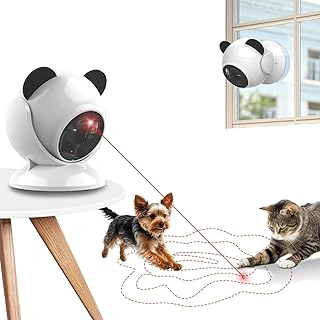
Saolife Automatic Laser Cat Toy with Random Trajectory, Suction Cup Design, Quiet
If you work from home or share your living space with a high-energy cat, the Saolife automatic laser toy offers random trajectory patterns without the high-pitched whir that interrupts video calls or evening relaxation. Rated 4.3 out of 5, this $19.99 toy uses a suction-cup mount that holds firm on hardwood floors, glass coffee tables, tile counters, and smooth furniture - surfaces where friction-base toys tend to walk or tip.
The random trajectory keeps restless cats guessing instead of learning a predictable loop, which matters when you need fifteen minutes of focused play before a meeting or bedtime. Because the unit recharges via USB, you skip the ongoing cost and drawer clutter of disposable batteries. The suction cup also lets you reposition the toy from floor to low table height, changing the chase angle without buying a second device.
This design works best on non-porous surfaces. If your home has thick carpet, textured stone, or unfinished wood, the suction cup will lose its grip quickly. The quiet motor and compact footprint make it a practical choice for apartments, but households with three or more cats may find a single laser point creates more competition than exercise.
For side-by-side comparison, check whether your flooring suits suction or wide-base stability, especially if you're managing multiple cats in one play session.
- ✅ Suction cup holds firm on hardwood, tile, and glass
- ✅ Random trajectory prevents pattern boredom
- ✅ Quiet motor suitable for Zoom calls and TV time
- ✅ USB rechargeable eliminates battery replacement cost
- ⚠️ Suction cup fails on carpet, textured stone, or unfinished wood
- ⚠️ Single laser point may cause competition in multi-cat homes
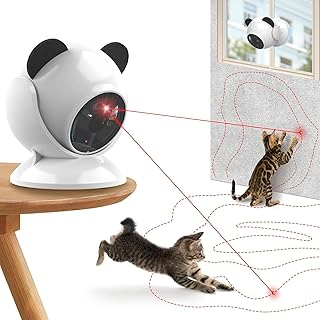
Sofolor Automatic Laser Cat Toy with Random Trajectory, Suction Cup, Quiet, USB Rechargeable
The Sofolor Automatic Laser Cat Toy uses a suction-cup mount and random trajectory pattern, making it suitable for households with smooth counters, glass surfaces, or lightly textured walls. Priced at $19.99 with a 4.2 rating, it runs on USB rechargeable power and operates with a quiet motor that won't startle sound-sensitive cats or wake light sleepers.
Random trajectory helps reduce the chance of one cat from camping at a predictable spot and monopolizing the dot. If you have two cats that compete for attention, this unpredictability helps both stay engaged without one dominating play. The suction cup works best on sealed tile, glass, or polished stone; it may lose grip on porous drywall or painted wood unless the surface is very smooth.
Because the unit mounts vertically or at an angle, you can aim the laser across floor and wall zones, giving cats vertical and horizontal chase opportunities in the same session. USB recharging reduces the need to stock AA batteries, though you'll need to remember to plug it in between sessions.
If your home has mostly textured walls or you prefer a unit that sits on the floor without mounting hardware, a weighted-base design will offer more flexibility. For smooth-surface households that want an affordable, rechargeable option with enough pattern variety to entertain multiple cats, the Sofolor delivers straightforward performance at the same $19.99 entry point as other compact models.
- ✅ Random trajectory keeps multiple cats engaged
- ✅ Suction cup works on smooth counters, glass, and sealed tile
- ✅ Quiet motor suitable for sound-sensitive cats
- ✅ USB rechargeable, no battery purchases
- ⚠️ Suction may fail on porous or textured walls
- ⚠️ Requires smooth surface for reliable mounting
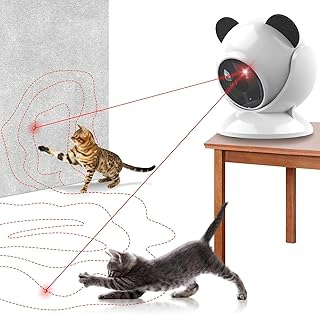
umosis Automatic Interactive Cat Laser Toy
Limited floor space doesn't mean limited play. The umosis Automatic Interactive Cat Laser Toy is built for smaller footprints - studio apartments, condos, or single-room setups where you can't dedicate an entire living area to cat entertainment. At $19.99 and rated 4.2 out of 5, it offers interactive trajectory control in a compact package that sits comfortably on a side table or narrow shelf without dominating the room.
The smaller housing keeps the device unobtrusive, but that compact design brings tradeoffs. Projection radius is naturally constrained compared to larger, tower-style models, so expect tighter laser patterns that work well within a multiple- to longer zone. Battery runtime may also be shorter due to the reduced internal space for power cells, meaning you'll likely recharge or swap batteries more frequently during high-activity periods. For single-cat households or cats who prefer short, intense bursts of play rather than marathon sessions, those limits rarely become friction points.
The interactive trajectory keeps movement unpredictable enough to hold attention even in confined quarters. Cats who get bored with straight-line lasers stay engaged when the pattern shifts direction within the smaller play zone. Setup is straightforward: place the unit on a stable surface at knee height or above, switch it on, and let the laser do the work. No wall mounting or complex calibration required.
If you're working with a larger open-plan living area or multiple high-energy cats who need simultaneous engagement, you'll want to compare projection radius and timer settings across models with bigger housings. But for tight spaces where every square foot counts, the umosis delivers focused play without clutter.
- ✅ Compact footprint suits small apartments and single-room play zones
- ✅ Interactive trajectory maintains engagement in confined spaces
- ✅ Simple tabletop setup with no mounting hardware needed
- ✅ Budget-friendly at $19.99
- ⚠️ Smaller projection radius limits play area coverage
- ⚠️ Compact housing may mean shorter battery runtime
- ⚠️ Less suitable for multi-cat or open-plan environments
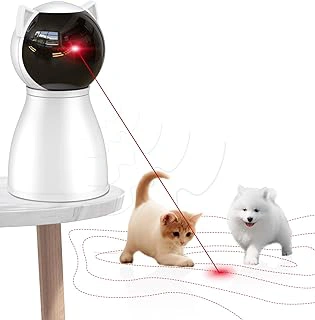
Valonii Automatic Motion-Activated Cat Laser Toy, Random Trajectory, Rechargeable
Owners who prefer truly hands-off play will appreciate the motion-sensor design of the Valonii Automatic Cat Laser Toy. When your cat walks within range, the sensor triggers a random trajectory pattern without manual scheduling or button presses. The rechargeable battery reduces the need for disposable cells, and the 4.2-star rating reflects solid field performance at $19.99.
Random trajectory keeps high-energy cats guessing, since the beam doesn't follow a predictable arc. This unpredictability can extend engagement for cats who lose interest in fixed patterns. The sensor responds to movement in a defined zone, so placement matters: position the toy where your cat naturally enters the room rather than a hallway humans frequent, or you'll find the laser firing every time someone walks past.
Because the motion trigger is automatic, you can't control the exact start time. If your cat prowls at multiple a.m., the toy will activate. Test the sensor sensitivity in your chosen spot before leaving it unattended all day. Some owners tape over part of the sensor lens to narrow the detection angle and reduce false triggers.
Rechargeable power means one USB cable replaces ongoing battery purchases, though you'll need to remember to top up the charge every few weeks depending on activation frequency. The unit lacks an adjustable timer, so the session length is preset - fine for short bursts, but less flexible than models with multiple duration settings.
This toy fits households where the cat's activity zones are predictable and separate from main foot traffic. If you want the laser ready whenever your cat is, and you're comfortable managing sensor placement, the motion-activation trades scheduling control for true automation.
- ✅ Motion sensor triggers play automatically when the cat approaches
- ✅ Random trajectory maintains unpredictability for high-energy cats
- ✅ Rechargeable battery eliminates disposable cell costs
- ✅ $19.99 price point
- ⚠️ Sensor may fire unexpectedly in high-traffic human zones
- ⚠️ No adjustable timer or session-length control
- ⚠️ Requires strategic placement to avoid false triggers
What to Compare Before You Buy an Automated Laser Toy
- Random vs. fixed trajectory: unpredictable paths sustain interest longer
- Suction-cup or weighted base: stability on tile, glass, and hardwood
- Noise level: motor hum can startle skittish cats or disturb light sleepers
- Battery type: rechargeable USB vs. replaceable AAA cells
- Timer and auto-shutoff: 10 - 15 minute cycles prevent overexertion
- Laser class and safety: Class II or lower, never direct eye exposure