We may earn a commission when you buy through links on this page, at no extra cost to you. How this works.
FRCFRC Automatic Self-Cleaning Cat Litter Box with App Control
A structured guide to evaluating self-cleaning litter boxes when managing multiple cats and a demanding schedule.
Use the matching tool first
Start with Smart Feeder Portion Calculator if you want to narrow the fit before checking current offers.
Multi-cat households face a specific challenge when choosing a self-cleaning litter box: the unit must handle higher waste volume without constant intervention, yet many models designed for capacity struggle with timely odor control or create disruption during video calls and focused work. The right choice depends on balancing three decision factors that rarely align perfectly in a single product.
Waste capacity determines how many days you can go between emptying the receptacle, but a larger bin does nothing if the box waits hours between cleaning cycles. A model that sifts after every exit keeps odor low and prevents territorial avoidance, though frequent mechanical action may become intrusive if your workspace sits near the litter area. For households with three or more cats, cycle frequency often matters more than raw storage volume.
Noise becomes a practical concern when cleaning cycles trigger during meetings or overnight. Some units complete a full rake cycle in under three minutes with minimal sound, while others grind through a five-minute sequence that carries through walls. If your schedule includes regular video calls or light-sleeping family members, understanding decibel range and cycle duration helps avoid regret after installation.
App-connected models add remote monitoring, manual cycle triggers, and waste-level alerts, typically at a $100 to $200 premium over non-connected versions with similar mechanics. The value proposition depends on whether you travel frequently, manage litter duties across multiple people, or simply want confirmation that the box cycled overnight. For some owners, a status light and consistent schedule remove the need for smartphone integration entirely.
This guide walks through each decision dimension with side-by-side comparisons, so you can identify which tradeoffs align with your household routine rather than chasing a one-size-fits-all recommendation.
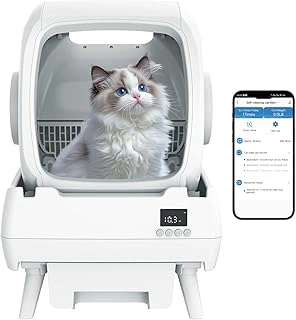
FRCFRC Automatic Self-Cleaning Cat Litter Box with App Control
The FRCFRC Automatic Self-Cleaning Cat Litter Box offers app control and programmable cycle timing at $149.99, placing it in the accessible price tier for households managing multiple cats. The smartphone app allows you to monitor cleaning cycles remotely and adjust timing based on your cats' bathroom patterns throughout the day.
This model uses automatic rake technology to sift waste into a covered compartment after each use. You can set delay intervals between cycles to accommodate back-to-back visits from different cats, which helps maintain box availability during peak morning and evening hours. The app interface displays cycle history and sends alerts when the waste drawer needs emptying.
At 4.2 out of 5 stars, user feedback indicates the unit handles moderate multi-cat traffic reliably, though some households with three or more cats report needing to empty the waste drawer daily rather than every few days.Check current price and availabilityto compare capacity specs and cycle customization options against higher-capacity models if your household generates waste volume that exceeds a standard drawer between empties.
The price-to-feature ratio makes this a practical entry point for busy owners who want remote monitoring without the cost of premium large-format units. Consider your household's daily litter box visit frequency and whether manual drawer checks fit your routine before committing to this capacity level.
- ✅ App control with remote cycle monitoring and timing adjustments
- ✅ $149.99 price point in accessible tier
- ✅ Programmable delay intervals accommodate multiple cats
- ⚠️ Waste drawer may require daily emptying in households with three or more cats
- ⚠️ Capacity limitations during heavy-use periods reported by some multi-cat owners
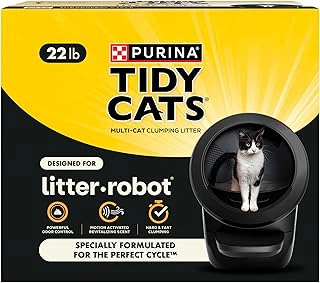
Purina Tidy Cats Clumping Odor Control Cat Litter for Litter-Robot
Choosing the right litter can make or break the performance of an automatic litter box in a multi-cat home. Purina Tidy Cats Clumping Odor Control Cat Litter for Litter-Robot is formulated to work with sensor-based systems, forming firm clumps that separate cleanly during the sifting cycle. With a 4.4 rating and a $19.98 price point, it sits in the accessible range for ongoing consumable costs when you're managing multiple cats.
Clumping speed matters in multi-cat households because frequent use means less time for litter to solidify before the next cycle. This formula is designed to form tight clusters quickly, reducing the chance of waste sticking to the drum or triggering false sensor readings. Dust control is equally important: excessive airborne particles can coat weight sensors and optical components, leading to skipped cycles or error messages. Users report that this litter produces moderate dust during pouring but settles quickly, which helps maintain sensor accuracy over time.
In a busy household, litter that clumps reliably and keeps sensors clear translates to fewer manual interventions and more consistent automatic operation. The odor control layer works to contain ammonia smells between cycles, though in a multi-cat setup you'll still want to monitor the waste drawer and top off litter regularly. Because this product is specifically labeled for Litter-Robot compatibility, it's engineered to meet the particle size and clumping firmness that automatic rakes and drums depend on.
For households running two or more cats through a single unit, stable clumping and low sensor interference are practical priorities that directly affect how often you'll need to troubleshoot or deep-clean the machine.
- ✅ Formulated for sensor-based automatic litter boxes
- ✅ Forms tight clumps quickly to support frequent multi-cat use
- ✅ Moderate dust levels help maintain sensor accuracy
- ✅ $19.98 price point keeps ongoing costs manageable
- ⚠️ Moderate dust during pouring requires careful handling
- ⚠️ Odor control may need supplementing in high-traffic multi-cat scenarios
Why Multi-Cat Households Need Different Criteria
Multi-cat households create unique demands that single-cat litter boxes simply aren't designed to handle. Two cats typically produce four to six waste events per day, while three or more cats can push that number past ten, filling waste drawers quickly and triggering more frequent cleaning cycles that strain motors and sensors not built for heavy use.
Waste volume is only part of the equation. Territorial dynamics mean some cats will wait for the box to cycle before entering, while others may avoid a unit that still carries scent from a recent deposit. If your self-cleaning box takes five or more minutes to complete a rake cycle, a queue can form during peak morning and evening hours, leading to accidents outside the box.
Capacity becomes the defining constraint. A standard 8-liter waste drawer might last a single cat ten days, but with three cats it will need emptying every two to three days. Smaller bins mean more frequent handling, which erases much of the convenience these units promise. Look for models offering at least 12-liter capacity if you're managing three or more cats, and expect to check waste levels every other day rather than weekly.
Cycle frequency matters as much as bin size. Units that auto-cycle after every use keep the box cleaner between visits, but continuous operation increases mechanical wear. Households with four or more cats should prioritize models with reinforced rake systems and manufacturer-rated duty cycles that match actual use, not just the marketing claim of "multi-cat ready."
Odor control escalates with more cats. Carbon filters work for light use, but higher traffic demands better sealing around the waste drawer and faster removal of clumps from the litter bed. If the unit doesn't cycle promptly or the drawer allows airflow, odor will break through within hours, not days.
The threshold is straightforward: if your household has three or more cats, treat capacity, cycle speed, and build durability as non-negotiable requirements, not bonus features.
Litter Type and Ongoing Cost Considerations
Litter compatibility shapes both the day-to-day reliability of automatic systems and the total cost of ownership in a multi-cat home. Most self-cleaning litter boxes work with standard clumping clay litter, though sensor accuracy and rake performance vary depending on granule size, dust levels, and clumping speed. Models that rely on weight sensors to detect when a cat has exited benefit from tighter, faster-clumping formulas that form distinct masses the rake can separate cleanly from unused litter.
Some manufacturers specify proprietary litter blends to ensure optimal sifting and odor control, which can raise monthly expenses considerably when multiple cats are using the box daily. A household with three cats may go through two to three times the litter volume of a single-cat home, turning a small per-bag price difference into a meaningful budget factor over a year. Standard clumping litters typically cost less per pound and offer wider brand choice, but switching formulas mid-use can confuse sensors calibrated to expect consistent granule weight and texture.
Silica crystal and pellet-based litters appear in some automated systems designed around tray or drawer mechanisms rather than raking scoops. These alternatives often produce less dust and track less than clay, but they also require the waste drawer to handle non-clumping solids and absorbed liquid differently. If your cats are accustomed to a particular litter texture, an abrupt change to meet equipment requirements can lead to avoidance behavior, so it's worth confirming litter flexibility before committing to a model.
Dust control matters more in automatic boxes because the rake or rotating drum stirs litter repeatedly throughout the day, releasing fine particles into the air each cycle. Low-dust or dust-free clumping formulas reduce the film that can coat sensors, camera lenses, and motor housings, cutting down on maintenance frequency. In a busy multi-cat household, where cycles may run ten or more times daily, that dust accumulation compounds quickly.
Evaluate both the upfront cost per bag and the volume your household will consume each month, then compare that figure against the convenience and performance trade-offs of proprietary versus standard options. Litter type is not a one-time decision; it directly affects sensor reliability, cleaning consistency, and whether the automation remains practical or becomes another chore to troubleshoot.
Introducing Multiple Cats to an Automatic System
Moving from traditional trays to an automatic system takes patience, especially when territorial habits are already established among multiple cats. The goal is to let each cat explore and use the unit before any motorized cycles create noise or motion that might scare them away.
Start by placing the new unit next to your existing litter boxes and leave it completely unplugged for three to five days. Fill it with the same litter your cats recognize, and let them investigate and use it at their own pace. During this phase, resist the urge to turn anything on - the box should feel like a familiar option, not a threat.
Once all cats have used the unplugged unit at least twice, enable automatic cycles but only when your cats are in another room or sleeping. Set the delay timer to its longest interval, typically fifteen to thirty minutes, so the machine waits until the area is clear. Watch for any cat that returns during a cycle; if one bolts or refuses to go near the box afterward, extend the unplugged phase by two more days.
Territorial blocking is common in multi-cat homes, where one dominant cat may guard the entrance or sit nearby to control access. If this happens, keep at least one traditional box available in a separate area so subordinate cats always have an escape route. Gradually reduce the delay timer by five-minute increments every three days, but only if all cats continue using the automatic unit without hesitation. The entire adjustment window usually spans two to three weeks, and slower is almost always safer than rushing a cat that already shows anxiety.
Noise, Scheduling, and Work-From-Home Compatibility
Automatic litter box motors, raking mechanisms, and waste drawer closures can range from a quiet hum to a noticeable scrape, and the difference matters when you spend most of your day working from home. Motor-driven rake systems typically produce a low mechanical sound lasting thirty to ninety seconds, while rotating globe designs may hum continuously during their cleaning cycle. Waste drawer latches can click audibly when they close, and some entry step platforms create a light tap when a cat jumps down.
App-based scheduling allows you to push cleaning cycles to times when household noise is already higher - lunch breaks, before morning meetings, or after you close your laptop for the day. Many units let you set quiet hours or manually delay a cycle if you're on a video call. Without scheduling control, most self-cleaning boxes run on a fixed timer after each exit, which can interrupt focused work or early-morning sleep.
Placement also shapes perception. A litter box tucked inside a laundry room or bathroom with the door half-closed will sound quieter than one placed two feet from your desk. Carpeted floors and upholstered furniture absorb some sound, while hardwood and tile amplify it. If your home office shares a wall with the litter box area, you'll hear every cycle more clearly than if the box sits down a hallway.
Test your tolerance during a typical work block. A brief mechanical sound every few hours may blend into ambient noise from HVAC, appliances, or street traffic. A louder or longer cycle can pull your attention away from tasks, especially in a quiet household. Scheduling flexibility and thoughtful placement give you control over when and how much you hear.
Safety Features and What 'Multi-Cat Rated' Actually Means
When a manufacturer labels a self-cleaning litter box as "multi-cat rated," the phrase usually refers to waste capacity and cycle frequency rather than safety features that account for more than one cat using the unit at the same time. A box rated for three cats typically means it can handle the volume those cats produce across a day, not that it can safely manage two cats inside or near the mechanism at once.
Weight sensors form the backbone of most automatic rake and rotating-drum systems. These sensors detect when a cat has entered, wait for the cat to exit, then start a countdown timer before the cleaning cycle begins. The sensor threshold matters: units calibrated for adult cats may ignore kittens under two pounds, while others trigger at any weight above eight ounces. If your household includes both a twelve-pound tabby and a four-pound kitten, check the minimum trigger weight to confirm all cats will activate the delay.
Pinch-point protection varies widely. Rotating drums often include obstacle detection that halts the cycle if resistance increases mid-rotation, which helps if a paw or tail enters the chamber during cleaning. Rake systems typically rely on the pre-cycle delay alone, since the rake itself offers fewer pinch risks than a rotating globe. Some models add infrared or optical sensors that scan the interior before each cycle, restarting the countdown if motion is detected.
Concurrent use remains the edge case most systems don't explicitly address. If one cat is inside when another jumps in, the weight sensor may register the combined total and reset the timer, but it won't prevent the second cat from startling the first or interfering with the sensor calibration. Households where cats routinely share the box at the same time should prioritize models with continuous motion detection rather than entry-exit weight logic alone.
The distinction between capacity rating and safety rating clarifies what "multi-cat" promises: enough room and frequent enough cycles to keep up with waste, but not necessarily redundant safeguards for overlapping use. Review the sensor type, minimum trigger weight, and whether the unit pauses for in-cycle motion before assuming the rating covers all multi-cat scenarios.
Maintenance Cadence: What 'Self-Cleaning' Doesn't Cover
Self-cleaning litter boxes automate the scooping cycle, but they don't eliminate maintenance. Understanding what you'll actually need to do helps avoid buyer's remorse and keeps the unit running reliably in a multi-cat home.
The waste drawer requires regular emptying. For two cats, expect to pull and dispose of the drawer every three to four days. Three or four cats will push that schedule to every other day, sometimes daily during shedding season when litter clumps are larger. Each emptying takes about two minutes: unlatch the drawer, tie off the liner if you use one, and snap in a fresh bag.
Monthly deep cleaning keeps sensors and mechanical parts accurate. Wipe down the rake or rotating globe with a damp cloth to remove dust and litter residue that can interfere with weight sensors or rotation. Check the litter bed for hardened clumps stuck to corners or seams, and rinse the waste drawer with mild soap to prevent odor buildup. This routine takes roughly ten minutes and reduces false cycles or missed clumps.
Consumable parts need scheduled replacement. Carbon filters typically last 30 to 60 days depending on the model and the number of cats. Waste drawer liners, while optional, simplify cleanup and cost a few dollars per box. Some units use proprietary litter or require specific clumping formulas to trigger sensors correctly, so factor ongoing litter costs into your budget.
In practice, budget five minutes every three to four days for drawer service, plus ten minutes once a month for a thorough wipe-down. That's far less than manual scooping twice daily, but it's not zero-effort. If your schedule makes even brief weekly tasks difficult, consider whether the time savings justify the upfront cost and consumable expenses.
When App Control Adds Real Value Versus When It's Overhead
App-connected litter boxes make the most sense when you travel frequently or need to track patterns for multiple cats. Remote monitoring lets you confirm cycles completed while you're away, and usage logs can reveal which cat is using the box more often - helpful if a veterinarian asks about frequency changes. Some apps send maintenance alerts based on actual waste load rather than fixed timers, which matters in multi-cat homes where usage spikes unpredictably.
Scheduling cycles around your household routine adds value if your cats react to motor noise during sleep hours or if you want the unit to clean right before you arrive home. A few models log individual entries when paired with microchip readers, useful for monitoring a cat recovering from surgery or managing a senior cat's bathroom habits.
Timer-based units without connectivity work well when your schedule stays consistent and you check the waste drawer daily anyway. You lose the ability to adjust settings remotely or receive low-litter warnings, but the unit still runs its cycle on the preset interval. If you're home most days and prefer a simpler setup, the subscription cost and app learning curve may outweigh the convenience.
Evaluate whether real-time alerts would change your behavior or simply duplicate what you already see in person. App control becomes overhead when it adds recurring fees, requires strong Wi-Fi near the litter box location, or introduces troubleshooting steps that wouldn't exist on a standalone timer. For households managing three or more cats or coordinating care with a pet sitter, the visibility often justifies the extra complexity.
Cost Analysis: Upfront Investment Versus Daily Maintenance Time
The purchase price tells only part of the story when evaluating a self-cleaning litter box for a multi-cat home. Understanding the full first-year cost - including the unit, compatible litter, replacement trays or filters, and electricity - helps frame the decision as a time-buyback calculation rather than a simple appliance expense.
A typical automated litter box for multiple cats ranges from $300 to $700 at purchase. Proprietary litter or waste receptacles add $15 to $40 per month, depending on the system and the number of cats. Replacement carbon filters, waste drawer liners, or cleaning solutions contribute another $5 to $15 monthly. Electricity consumption is modest - most models draw between 15 and 50 watts during cleaning cycles - adding roughly $3 to $8 annually to your utility bill.
Totaling these expenses, expect a first-year outlay of approximately $500 to $1,000, with ongoing costs of $250 to $600 each subsequent year. Traditional clumping litter for manual scooping costs $20 to $40 monthly, or $240 to $480 annually, so the consumable savings are minimal.
The real value emerges in time reclaimed. Manual scooping in a multi-cat household takes five to ten minutes each day - sometimes twice daily if odor or litter-box traffic becomes an issue. Over a year, that totals 30 to 60 hours spent on litter maintenance. An automated system reduces your active involvement to periodic waste-drawer emptying and occasional deep cleaning, typically five to ten minutes every few days.
If you value your time at even a modest hourly rate, the labor savings can justify the upfront investment within the first year. Households juggling work schedules, children, or other pets often find the convenience worth the premium, while budget-focused owners may prefer to continue manual scooping and redirect funds elsewhere.
Consider your household's specific rhythm: if you travel frequently, work long hours, or simply dislike the daily chore, the time buyback may outweigh the cost difference. If you're home consistently and scooping fits comfortably into your routine, a high-capacity traditional box with quality clumping litter remains a viable, lower-cost option.
The Verdict: Matching Your Household Constraints to the Right System
The best self-cleaning litter box for your multi-cat household depends less on feature lists and more on which constraints dominate your daily routine. If you travel frequently or work long shifts, prioritize waste capacity and cycle frequency - a model that runs after every use and holds a week's worth of waste from three cats will prevent odor buildup when you can't empty the drawer twice a day. If you're home most of the time but want insight into elimination patterns or alerts when a cat skips the box, app control and health monitoring become the deciding factors, especially when one cat has a chronic condition.
Noise and scheduling matter most if you work from home or have cats that startle easily. A box that lets you delay cycles until after your morning meetings, or one with a quieter rake mechanism, reduces disruption without sacrificing automation. Maintenance tolerance also shapes the choice: some owners prefer a simpler tray-and-liner system they can rinse quickly, while others accept a more complex waste drawer if it means fewer trips to the trash.
Cat count sets the floor for capacity, but your own schedule and preferences determine which trade-offs you're willing to make. A four-cat household with someone home all day has different needs than a two-cat household where both owners commute. Compare the featured models using the capacity, cycle timing, app features, and noise characteristics that align with your specific situation, then verify specs for the models that match your top two or three priorities.
Decision Matrix: What to Compare Before You Buy
- Waste bin capacity in liters and estimated days between emptying for your cat count
- Cycle delay options: immediate, timed, or app-triggered cleaning modes
- Entry dimensions and weight limits if you have larger breed cats
- Decibel rating and whether cycles can be scheduled outside sleep hours
- App features: usage tracking per cat, maintenance alerts, remote start capability
- Litter type compatibility: clumping clay, silica crystal, or brand-specific requirements