We may earn a commission when you buy through links on this page, at no extra cost to you. How this works.
AWoHH 90 Pack Cat Litter Box Robot Model 5/4/3 Automatic Liners, 9-11 Gallon
Two flagship automated litter boxes, one decision: which premium system fits your home and schedule?
Choosing between the Litter-Robot 4 and Leo's Loo Too means deciding which automated cleaning approach fits your household routine, space constraints, and expectations for daily intervention. Both systems eliminate the chore of manual scooping, yet they differ substantially in how waste is cycled, how often you'll empty drawers, and how deeply their apps integrate into your smart-home ecosystem.
The Litter-Robot 4 uses a rotating globe and sifting mechanism that deposits clumps into a lined drawer below. Leo's Loo Too employs a front-loading rake that sweeps waste into a separate compartment. These engineering choices ripple into form factor, noise profile, and how quickly odor builds between drawer changes.
Busy professionals often prioritize three factors: how many days the unit can run unattended with multiple cats, whether the app provides reliable status alerts, and how the box looks in a visible living area. Aesthetics matter when a litter box occupies a corner of your kitchen or bathroom rather than a basement utility room. Design language, footprint, and the visibility of waste through transparent panels all influence daily comfort.
This comparison walks through each system side by side: exterior and interior design, odor containment methods, cleaning-cycle mechanics, app notifications and connectivity, routine maintenance tasks, and the total investment including consumables over the first year. By the end, you'll understand which tradeoffs align with your household's rhythm and which friction points you're willing to accept in exchange for automation benefits.
Meet the Contenders: Litter-Robot 4 and Leo's Loo Too
The Litter-Robot 4, made by Whisker, uses a rotating globe mechanism that sifts waste into a drawer below after each cycle. Its footprint measures approximately 27 inches tall and 22 inches wide, and it accommodates cats weighing up to about 25 pounds. The system is designed for single or multi-cat households, with a larger waste drawer that extends the time between empties when multiple cats share the unit.
Leo's Loo Too, from Casa Leo, takes a different approach with a vertical sifting drawer system. The unit sits lower to the ground, measuring roughly 24 inches in height and 24 inches in diameter, and supports cats up to 20 pounds. Its sifting mechanism pulls waste downward through a rotating screen, separating clumps from clean litter before depositing them into a collection tray.
Both systems require clumping litter and connect to smartphone apps for cycle monitoring and notifications. The Litter-Robot 4's globe design means cats enter through a single opening and step onto a curved surface, while Leo's Loo Too offers a wider, front-facing entry with a flatter interior floor. Weight sensors in each unit detect when a cat enters and exits, triggering an automatic cleaning cycle after a preset delay.
Whisker has sold automated litter boxes for over two decades, while Casa Leo entered the market more recently with a focus on compact, drawer-style automation. The choice between rotation and sifting affects how litter is agitated, how much noise each cycle produces, and how easily you can access the waste compartment for disposal.
Design and Living-Space Integration
Both the Litter-Robot 4 and Leo's Loo Too occupy a similar footprint - roughly 27 inches tall and 22 - 24 inches wide - but their visual presence in a room differs significantly. The Litter-Robot 4 uses a gray-and-white glossy plastic shell with rounded edges and a translucent waste drawer visible at the base. Leo's Loo Too offers a matte finish in white or gray, with a more enclosed drawer that tucks behind a front panel. In a bathroom or bedroom corner with curated decor, the Leo's Loo reads slightly more like a piece of modern furniture, while the Litter-Robot's globe shape and transparent drawer announce its purpose more openly.
Noise varies by cycle stage. The Litter-Robot 4 produces a low motor hum during rotation and a brief beep when the cycle completes; owners report the sound carries through open doors but remains quieter than a microwave. Leo's Loo Too runs a similar rotation motor but adds a UV sterilization cycle that hums for several minutes after sifting. Neither unit is silent, though both are quieter than older drum-style models. If the box sits in a laundry room or utility closet, noise is rarely an issue. In a studio apartment or open-plan layout, expect to hear cycles during the night.
Material quality also affects long-term appearance. The Litter-Robot 4's glossy surfaces show dust and paw prints more readily, requiring weekly wipes to maintain a clean look. Leo's Loo Too's matte shell hides smudges better but can accumulate fine litter dust in seams around the entry. Both units use durable ABS plastic and stainless-steel sifting components, so scratches from cats or routine cleaning remain minimal over months of use.
Waste drawer visibility matters if the box lives in a high-traffic area. The Litter-Robot 4's clear lower section lets you gauge fill level at a glance but also displays clumps through the plastic. Leo's Loo Too conceals the drawer fully until you pull the front panel, which may suit bedrooms or guest bathrooms where discretion matters. Weight capacity and stability are comparable - both units handle cats up to 25 pounds without tipping, and neither rocks during normal entry or exit.
Choose the Litter-Robot 4 if you value quick visual checks and don't mind a more appliance-like profile. Opt for Leo's Loo Too if you prioritize a subdued look in visible spaces and prefer waste storage that stays out of sight until you're ready to change the liner.
Cleaning Cycles and Odor Control Performance
Both the Litter-Robot 4 and Leo's Loo Too rely on weight sensors to detect when a cat exits the box, then initiate a timed cleaning cycle. The Litter-Robot 4 waits three, seven, or fifteen minutes - your choice - before rotating its globe to sift clumps into a lined drawer below. The entire rotation takes about two and a half minutes. Leo's Loo Too uses a similar delay window and begins its rake-style cycle roughly ninety seconds after your cat leaves, completing the scoop in under three minutes. Both systems let you adjust wait times through their apps, which matters if you have a skittish cat who circles back or a curious kitten who lingers near the entrance.
Sensor reliability shapes daily experience. The Litter-Robot 4 uses a capacitive sensor beneath the step and globe, which consistently reads weight changes across the entry mat. Leo's Loo Too employs pressure pads under the basin. In multi-cat homes, back-to-back entries can sometimes confuse the countdown timer on either unit, though firmware updates have improved detection logic for both. If two cats use the box within seconds of each other, the cycle resets its delay rather than starting mid-visit.
Odor containment follows different strategies. The Litter-Robot 4 funnels waste into a fully enclosed carbon-filtered drawer that you pull out from the base. The drawer liner captures odor between cycles, and the carbon filter sits in the drawer's front panel. Leo's Loo Too uses a front-mounted waste bin with a carbon filter embedded in the lid. The bin is not as deeply sealed during storage, so some households notice faint odor near the unit after twenty-four hours in warm weather. Both models work best with clumping clay litter; crystal and pine pellets can jam the sifting mechanisms or slip through the screen gaps.
Clumping performance drives real-world containment. If litter clumps break apart during the cleaning cycle, fragments remain in the bed and begin to smell. The Litter-Robot's rotational sifting distributes force more evenly, reducing clump breakage with most premium clay litters. Leo's Loo's rake can fracture softer clumps if the litter bed is shallow or if your cat buries waste near the back wall where the rake exerts more pressure. Keeping the bed depth at the recommended three to four inches mitigates this on both units.
Extended trips test capacity and odor control. The Litter-Robot 4's drawer holds roughly two weeks of waste for a single cat, assuming typical clumping clay and normal elimination frequency. Leo's Loo Too's bin is slightly smaller; expect ten to twelve days for one cat. In a two-cat household, plan to empty every five to seven days for the Litter-Robot and every four to six for Leo's Loo. Both apps send full-drawer alerts based on cycle count rather than actual fill level, so you may need to empty sooner if your cats produce unusually large clumps or if you run extra manual cycles.
Daily odor management hinges on liner discipline and filter replacement. Swap carbon filters every one to three months depending on household size and ventilation. Use well-fitted liners to prevent leaks at the drawer seams, especially if you wait until the full-drawer alert. If you notice persistent odor between changes, inspect the waste port and sifting screen for caked litter or clump residue that traps bacteria. Both units benefit from a weekly wipe-down of the entry step and interior surfaces with enzyme cleaner, which neither manual emphasizes but makes a measurable difference in homes with three or more cats.
Smart Features and App Connectivity
App connectivity turns a timer-based appliance into a monitoring tool. Litter-Robot 4 pairs with the Whisker app, which records cycle history, sends maintenance reminders, and allows manual cycling from anywhere. The app tracks each visit and displays waste-drawer level in real time, which helps identify changes in frequency before they become obvious. You can name multiple units, set custom cleaning schedules, and share access with other household members. Alexa and Google Home integration lets you trigger a cycle by voice, though most users rely on the app interface.
Leo's Loo Too includes basic app functionality through a dedicated mobile app that logs usage, sends full-drawer alerts, and triggers on-demand cleaning. The interface is straightforward: you see cycle counts and can start a cleaning remotely. Multi-cat households will find the event log useful, but the data presentation is less detailed than Whisker's dashboard. There is no native smart-home integration, so voice control is not an option. The app stability improved after early firmware updates, but some users still report occasional connection drops that require router proximity adjustments.
Whisker's platform offers richer health insights because it pairs usage frequency with weight tracking through the optional scale accessory, creating a timeline that flags sudden changes. Leo's app records visits but does not integrate weight data or produce trend graphs. Both apps require WiFi during setup and will function offline in autonomous mode, but remote monitoring and alerts disappear until reconnection. Privacy policies for both vendors state that usage data stays on your account and is not sold; review the terms if you have concerns about cloud-connected pet devices.
For owners who travel frequently or manage multiple cats, the Whisker app provides more actionable information and better notification customization. Leo's app covers the essentials without adding complexity, which suits users who want alerts but do not need this product analytics.
Setup, Maintenance, and Day-to-Day Reality
Setting up either machine requires more than unboxing and plugging in. The Litter-Robot 4 arrives mostly assembled, but you'll still spend 15 - 20 minutes attaching the bonnet, installing the carbon filter, and filling the globe with roughly 8 - 10 pounds of clumping litter. Leo's Loo Too ships in more pieces: you'll snap the drum into the base, secure the waste drawer, and pour in 7 - 9 pounds of litter. Both manufacturers recommend a slow introduction - leave the unit unplugged for a few days so your cat explores it as a static box before the motor startles them.
Daily interaction centers on the waste drawer. Litter-Robot 4's drawer sits lower and pulls straight out, while Leo's Loo Too uses a top-loading tray beneath the drum. With one cat, expect to empty either unit every 5 - 7 days; two cats push that to every 3 - 4 days. Both accept standard kitchen bags, though proprietary liners fit more snugly and cost around $1 - $1.50 per liner when bought in bulk. Carbon filters need swapping every month, running roughly $5 - $7 per filter regardless of brand.
Jammed cycles happen when clumps stick to the drum wall or a cat re-enters mid-rotation. The Litter-Robot 4 halts and flashes a pinch-sensor alert; you manually rotate the globe a quarter turn to dislodge the blockage. Leo's Loo Too pauses and sends an app notification, but its narrower drum opening makes it harder to reach inside and clear wet litter by hand. Weight-sensor false positives - where the unit thinks a cat is present when it isn't - are more common on Leo's Loo Too if you place it on carpet or an uneven surface; hard floors minimize drift.
Deep cleaning means disassembling the globe or drum and rinsing off caked litter dust. Plan on this every 4 - 6 weeks. The Litter-Robot 4's globe is heavier and awkward to carry to a tub, but it separates from the base with two latch clips. Leo's Loo Too's drum lifts out more easily, yet the rubber seal around the waste port collects grime and requires scrubbing with a small brush. Replacement parts - pinch sensors, motors, waste drawer panels - are available directly from each manufacturer, though lead times can stretch to two weeks during peak periods.
Customer support responsiveness differs. Litter-Robot maintains a phone line and live chat with typical wait times under ten minutes; their warranty service often ships replacement components overnight. Leo's Loo Too relies on email ticketing and an in-app chat bot that escalates to a human agent within 24 hours; replacement parts ship standard ground. Neither company charges for parts under warranty, but out-of-warranty motors run $80 - $120, and control boards cost $60 - $90. If you're comfortable with screwdrivers and following video guides, most repairs take 20 - 30 minutes; if not, factor in the cost of a service call or the inconvenience of shipping the entire unit back.
Consumable expenses add up over a year. Budget roughly $60 - $80 annually for liners, $60 - $85 for filters, and $200 - $300 for clumping litter, depending on brand and local pricing. Neither unit demands a specific litter formula, but fine-grain clumps reduce tracking and make sifting smoother. The real day-to-day reality is that automated boxes shift labor from scooping to monitoring: you'll check the app for cycle completions, clear the occasional jam, and keep an eye on litter depth so the sensor doesn't misread an empty globe as a full one.
Price, Warranty, and Long-Term Value
The Litter-Robot 4 typically retails around $649, while Leo's Loo Too sits closer to $649 - $699 depending on retailer promotions and bundle options. Both units ship free within the contiguous United States, and each manufacturer offers a 90-day trial window, giving you a full season to decide whether automated scooping fits your household.
Litter-Robot backs its units with an 18-month limited warranty covering mechanical and electrical defects, and you can extend protection to three years for an additional $89. Leo's Loo includes a one-year limited warranty, extendable to two or three years through similar optional plans. If you plan to keep the box beyond the trial period, budgeting for the extended coverage makes sense - motor assemblies and sensor boards are expensive to replace out-of-pocket.
Consumable costs tip the balance over time. Litter-Robot 4 uses proprietary drawer liners that run about $2.50 per liner when bought in bulk; depending on the number of cats and waste volume, expect to replace liners every three to seven days. Carbon filters last roughly three months at $6 - $8 each. Leo's Loo accepts standard tall kitchen bags, bringing liner cost down to around $0.25 - $0.50 per change, and its activated-carbon tray cartridges last two to three months at $10 - $12 apiece. Over three years with one cat, the Litter-Robot system may cost an additional $200 - $300 in liners and filters compared to Leo's Loo, assuming equivalent litter consumption.
Both machines reduce litter waste through efficient sifting, but clumping litter remains your largest recurring expense. Budget $15 - $25 per month for premium clumping clay or plant-based formulas that minimize tracking and dust. Neither unit requires specialty litter, so you retain flexibility to switch brands as prices fluctuate.
Resale value holds reasonably well for both brands on secondary markets, particularly if you retain the original box and documentation. Litter-Robot enjoys slightly stronger name recognition, which can translate to faster sales, but condition and cleanliness matter more than badge. Well-maintained units often fetch 50 - 60% of original retail after two years.
Calculating value strictly by dollars misses the larger picture. If manual scooping takes five minutes twice daily, an automated box reclaims roughly 60 hours per year - time you can redirect toward play, training, or simply enjoying your cat's company. For busy professionals working long shifts or managing multi-cat households, that time savings and the reduction in odor complaints justify the premium over $50 manual boxes. The question becomes whether the machine's reliability and your household's specific waste patterns align well enough to deliver consistent, low-touch operation across years of daily cycles.
The Verdict: Matching System to Lifestyle
Choosing between the Litter-Robot 4 and Leo's Loo Too comes down to household size, noise tolerance, and how often you want to handle waste. The Litter-Robot 4 fits multi-cat homes better because its larger waste drawer stretches the time between trips to the bin, and the app gives you real-time weight trends and cycle counts that matter when you're tracking multiple cats. Leo's Loo Too works well for single-cat owners who prefer quieter operation and don't mind emptying a smaller drawer more frequently in exchange for simpler upkeep and a lower entry price.
Both systems cut daily scooping to zero and contain odor effectively when you pair them with clumping litter and regular drawer changes. Neither replaces the need to monitor your cat's health, refill litter, or wipe down sensors, but each handles the most repetitive chore so you can focus on the parts of pet care that actually require your attention. If you share your home with two or more cats and rely on app notifications to stay organized, the Litter-Robot 4 justifies its higher cost through capacity and connectivity. If you have one cat and value a quieter cycle that won't wake you at night, Leo's Loo Too delivers consistent performance without the feature overhead.
Both carry premium price tags, but the time savings compound quickly for professionals who travel or work long hours. The real tradeoff isn't quality - it's whether you optimize for capacity and data or for simplicity and sound. Revisit the decision checklist above, then compare current pricing and availability for both units to see which aligns with your household rhythm and budget.
Next Steps: Compare Live Pricing and Read User Experiences
Before you commit to either system, check current pricing and shipping timelines on both the manufacturer sites and Amazon. Prices fluctuate with promotions, and shipping can vary by region - details that matter when you're spending several hundred dollars on a litter box.
Read verified customer reviews on both retailer pages and independent forums. Early adopters often document setup quirks, long-term durability, and real-world odor control that official marketing doesn't cover. Pay attention to recurring themes: if multiple users mention a specific sensor issue or a design flaw, that pattern is worth considering.
Visit the manufacturer FAQ and warranty pages for Whisker (Litter-Robot 4) and Casa Leo (Leo's Loo Too). Understand what's covered, how long the warranty lasts, and what the return window looks like. Some buyers discover that return shipping costs or restocking fees change the equation, especially for bulky items.
Brand communities and subreddit threads can be goldmine resources for troubleshooting tips, firmware update experiences, and compatibility advice for multi-cat households. Owners who've used their units for six months or more provide the kind of detail that helps you anticipate maintenance rhythms and potential pain points.
Treat this step as your final research checkpoint. You've compared features, understood the tradeoffs, and identified which system aligns with your household needs - now confirm that the price, availability, and support infrastructure match your expectations before you buy.
Decision Checklist: Which System Fits Your Home?
- Space constraints: measure available floor area and clearance for rotating globe (Litter-Robot 4) or tighter-corner fit with front drawer access (Leo's Loo Too)
- Multi-cat household: confirm weight sensors and cycle frequency support your pet count and size range
- Aesthetic priority: decide whether appliance-like design or softer styling better matches your interior
- Travel frequency: evaluate app reliability and extended-absence waste capacity for both models
- Maintenance preference: choose between frequent small drawer changes (Leo's Loo) or less-frequent larger hauls (Litter-Robot 4)
- Budget flexibility: compare upfront cost plus three-year consumables (liners, filters, litter type compatibility)
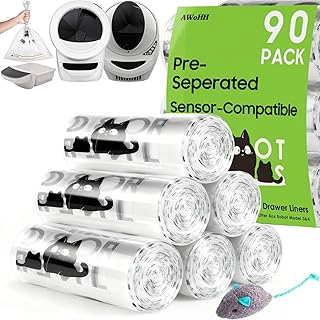
AWoHH 90 Pack Cat Litter Box Robot Model 5/4/3 Automatic Liners, 9-11 Gallon
Maintaining an automated litter box involves managing the waste drawer, and disposable liners can save significant time during drawer changes. The AWoHH 90 Pack is designed to fit Litter-Robot models 3, 4, and 5, with a 9-11 gallon capacity that matches the drawer dimensions. Each liner creates a barrier between waste and the drawer surface, allowing you to lift out and replace in seconds rather than scrubbing residue.
At $19.99 for multipleiners, the per-unit cost is roughly the listed amount - reasonable when weighed against the convenience of skipping manual cleaning. Busy professionals who prioritize speed over incremental expense will find the trade-off worthwhile, especially during weeks when multiple drawer changes are needed. The liners fit snugly around the drawer edges, and they hold up well under typical waste loads without tearing.
One consideration: liners are an ongoing expense, and some owners prefer washing the drawer to reduce waste and recurring costs. If you empty the drawer every three to four days and don't mind a quick rinse, liners become optional rather than essential. However, for those managing multiple cats or traveling frequently, having a 90-pack on hand extends the time between deep cleans and keeps the routine as hands-off as possible.
The AWoHH pack offers broad compatibility across Litter-Robot generations, so you won't need to reorder if you upgrade your unit in the future. When evaluating whether to invest, compare the time you'd spend scrubbing each drawer against the cumulative liner cost over a year - many users find that the simplicity justifies the expense, particularly during high-use periods.
- ✅ 90-pack offers extended supply at $19.99 ($0.22 per liner)
- ✅ Fits Litter-Robot models 3, 4, and 5 with 9-11 gallon capacity
- ✅ Eliminates manual scrubbing and speeds up drawer changes
- ✅ Holds up under typical waste loads without tearing
- ⚠️ Ongoing expense compared to washing the drawer
- ⚠️ Adds disposable waste to household output
- ⚠️ Optional accessory - not required for unit operation

Whisker OdorTrap Pod Refills (6 Pack) for Litter-Robot
Whisker's OdorTrap Pod Refills are carbon-activated inserts designed to slot into the waste drawer of the Litter-Robot 4, targeting ammonia and organic odors at the source. Each 6-pack provides roughly six weeks of odor control for a single cat, based on the recommended weekly replacement cycle. The carbon activation neutralizes scent compounds rather than masking them with fragrance, which makes the system suitable for households sensitive to artificial scents or those with open-plan living areas where litter odor can migrate.
The pod design integrates directly into the Litter-Robot 4 drawer without requiring modification or adhesive mounts. You simply swap the old pod out during routine waste disposal, which aligns with typical maintenance intervals. At $14.99 per 6-pack, the recurring cost adds approximately the listed amount per week to operating expenses for a single cat household. Multi-cat environments will consume pods faster depending on litter box traffic and waste volume.
Compared to alternative odor control methods, OdorTrap pods offer targeted, drawer-level intervention. Baking soda mixed into litter provides some odor suppression but requires frequent stirring and replenishment. Scented litters introduce fragrance that may irritate sensitive cats or mask rather than neutralize odors. External air purifiers address room-level air quality but do not concentrate effort inside the waste drawer where odor originates. OdorTrap pods focus exclusively on the containment zone, which works well for users who prioritize a scent-free environment without layering multiple odor management systems.
The 4.3 out of 5 rating reflects consistent performance, though effectiveness varies with household ventilation, humidity, and the number of cats. In well-ventilated spaces or single-cat homes, one pod per week typically suffices. In more humid climates or multi-cat setups, odor may break through sooner, requiring mid-week replacement or supplementary control measures. Before committing to a subscription model, assess your household's odor sensitivity and ventilation conditions during a single 6-pack trial. The investment makes the most sense for users who already own a Litter-Robot 4 and want to maximize drawer containment without relying on scented products or external devices.
View OdorTrap refill options