We may earn a commission when you buy through links on this page, at no extra cost to you. How this works.
Apartment cats face a distinct challenge: their energy peaks mid-morning and late afternoon, exactly when most owners are out. Without an outlet, that drive turns into climbing curtains, knocking objects off counters, or waking you at 4 a.m. Motion-activated toys address this by restarting play cycles automatically, keeping your cat engaged without you standing over them with a wand.
High-rise living adds three hard constraints. First, noise travels through walls and floors, so toys with loud motors or rattling components draw complaints. Second, square footage is limited - bulky toys crowd your living space and reduce usable floor area. Third, automated toys left running all day drain batteries or rack up energy costs, so efficient standby modes and reliable motion detection become essential.
Motion sensors solve the engagement problem by detecting when your cat approaches, triggering movement, then returning to sleep mode when play ends. This reduces runtime, cuts noise exposure, and preserves battery life. The sensor also introduces unpredictability: your cat can't learn a fixed schedule, which maintains interest longer than timed toys that always activate at 3 p.m.
The best motion-activated toys for apartments balance three attributes: a compact footprint that fits under furniture or in corners, quiet motors rated below 50 decibels, and fast sensor response that catches your cat's attention before they walk away. Toys that fail on noise generate neighbor friction; toys that fail on size become obstacles; toys with slow or unreliable sensors frustrate cats and get ignored within days.
How Motion Sensors Change Solo Play for Indoor Cats
Motion sensors turn automated toys into responsive playmates rather than repetitive distractions. When a sensor detects your cat approaching, the toy springs to life - feathers spin, lights activate, or a wand begins to twitch - creating the illusion of prey that reacts to your cat's presence. This on-demand activation mirrors the start-and-stop rhythm of real hunting, where movement begins only when the predator closes in.
Toys without motion sensors either run on fixed timers or require you to press a button each time. Timed toys cycle through their routines whether your cat is in the room or fast asleep three doors away, draining batteries and turning novel stimulation into white noise your cat learns to ignore. Manual-start toys depend on you being home and available, which defeats the purpose of solo play during work hours or overnight.
Motion-activated designs conserve power by staying dormant when the room is empty. A typical sensor will trigger within one to three feet of approach, then shut off after 10 to 30 seconds of inactivity. This intermittent pattern keeps the toy unpredictable and prevents your cat from habituating to constant motion. In apartments where you may be gone eight or ten hours, a motion-sensor toy remains ready without running itself dead or creating continuous noise that bothers neighbors.
The sensor also filters engagement: your cat chooses when to play by walking up, rather than the toy dictating the schedule. Cats that prefer ambush-style hunting can circle, pause, and stalk before the sensor fires. Cats that lose interest quickly benefit from the toy going quiet, then reactivating minutes later when curiosity brings them back. This self-regulating loop works particularly well in high-rises where space is limited and you can't scatter a dozen static toys across the floor.
Comparing Noise Profiles: Feathers, Lasers, and Rolling Balls
Sound matters when you share walls, floors, and ceilings with neighbors. Each motion-activated toy generates a distinct noise profile that depends on motor design, materials, and how the toy interacts with your floor.
Feather-wand toys rely on a small motor to rotate or swing fabric attachments. The motor itself produces a low hum, usually audible within a few feet but rarely through walls. The fabric flutter adds a soft swishing sound that most cats find irresistible but disappears entirely when the toy pauses between motion cycles. These units work well in living rooms during daytime hours and won't disturb light sleepers in adjacent bedrooms.
Laser toys create the quietest operation overall. The motor drives a mirror or prism to redirect the beam, producing a faint whir that stays localized to the device. Because the laser never touches the floor, there's no impact sound or surface friction. You can run a laser toy in a bedroom at night or in a room that shares a wall with a neighbor's quiet space. The tradeoff is that some cats lose interest faster without tactile feedback.
Rolling-ball toys generate the most audible sound. The ball itself creates friction as it moves across tile, hardwood, or low-pile carpet, and any collision with this product or furniture adds impact noise. Motors that drive the ball or shuffle it between chambers contribute additional hum. Ball toys suit thick carpet or daytime play sessions in rooms with fewer shared surfaces. If your apartment sits above another unit, place a rubber mat or foam tile under the toy to dampen vibration transfer.
Among the three products reviewed earlier, the laser model delivers the quietest performance for late-evening use. The feather toy ranks second, with audible flutter that remains apartment-appropriate. The rolling-ball option produces the most sound but offers the highest engagement for active cats willing to chase across open floor space. Match your toy choice to your floor type, your neighbor proximity, and the hours your cat plays most.
Footprint and Storage: Making the Most of Limited Floor Space
High-rise apartments rarely offer the luxury of extra floor space, so the physical footprint of an automated toy matters as much as its features. Rotating base toys typically occupy a circular footprint between 10 and 14 inches in diameter, and their motors require them to sit flat on open floor during play. Mat-and-ball systems spread wider - often 24 to 30 inches across - but their low profile allows them to slide under coffee tables or sofas when your cat loses interest.
Cord management becomes critical in narrow hallways and compact living rooms. Battery-powered toys eliminate the trip hazard of a trailing cable, though you'll need to plan charging cycles or keep spare batteries on hand. Plug-in models with six-foot cords offer uninterrupted operation but limit placement options unless you invest in a low-profile extension cord routed along this product. Charging docks for rechargeable models add another 4 to 6 inches of depth, so measure your intended spot before assuming a toy will fit flush against a wall.
Toys with vertical wands or feather arms need clearance above and around them - usually 18 to 24 inches in all directions - to avoid snagging on chair legs or curtains. If your layout includes tight corners or furniture clusters, prioritize compact disc or track designs that keep motion contained within a defined boundary. For studios or one-bedroom apartments, look for toys with detachable components that nest together for closet storage between sessions, reducing the permanent claim on your floor to near zero.
Battery Life and Power Management for Long Workdays
Motion-activated cat toys rely on power sources that vary widely in their ability to keep pace with a typical nine-hour workday. Battery-powered models may deliver anywhere from three to twelve hours of active play time, depending on sensor sensitivity and motor load. Toys with aggressive vibration or high-speed motors drain faster, while LED wands and rolling balls with intermittent activation tend to conserve charge more effectively.
USB-rechargeable options sidestep the cost and waste of disposable batteries but require overnight charging cycles. Plug-in designs eliminate mid-day shutdowns entirely, though they tie the toy to an outlet and limit placement flexibility in open-plan apartments. Standby power draw is negligible in most motion-sensor toys - less than one watt when idle - so leaving the unit plugged in between play sessions adds minimal cost.
Auto-shutoff timers address two practical concerns: preventing overstimulation during extended solo play and conserving battery when motion is detected continuously. Common intervals range from fifteen to thirty minutes of uninterrupted activity, after which the toy enters a cooldown period or powers off completely. Toys without this feature may exhaust their charge within hours if a curious cat triggers the sensor repeatedly, leaving the unit inactive by the time you return home.
If your schedule includes long stretches away from the apartment, prioritize plug-in or rechargeable models with built-in timers. Battery-only toys work well for shorter absences or as backup entertainment when outlets are inconvenient, but plan to recharge or replace cells every few days under regular use.
Which Toy Fits Your Cat's Play Style and Your Apartment Layout
Matching a motion-sensor toy to your cat's natural hunting preference and your apartment's floor plan prevents buyer's remorse and keeps both you and your neighbors happy.
Cats that bat and pounce at dangling objects respond best to feather-wand toys with automated arm movement. These devices mimic prey dangling from above, which appeals to cats that prefer vertical strikes rather than floor chases. In open-plan apartments, position the feather toy near furniture corners where your cat already ambushes passing feet; the motion sensor will trigger when your cat approaches, rewarding stalking behavior without requiring you to be home.
Chasers - cats that sprint across rooms after fast-moving targets - benefit from laser combination units that project dots across wide areas. These work well in living rooms or hallways with clear sight lines, because the laser can sweep 10 to 15 feet without obstruction. If your apartment layout includes narrow corridors or multiple small rooms, a laser toy may frustrate your cat when the dot disappears behind furniture or doorways mid-chase.
Solo stalkers, the cats that crouch and watch before a single calculated strike, often prefer maze ball toys or enclosed track systems. These contained designs suit tight spaces: place one under a console table or beside the couch, and the motion sensor activates when your cat investigates. The smaller footprint also means less floor clutter in studio or one-bedroom units.
Noise is the second filter. Laser units typically produce the quietest operation - a faint motor hum and occasional beep - making them the safest choice if your bedroom shares a wall with a neighbor. Feather-wand motors generate more audible clicking as the arm changes direction, and maze balls can rattle when batted across hardwood. If sound transmission is a concern, check each product's motor type and flooring compatibility before purchasing.
Review the side-by-side comparison above using these three categories - play style, layout compatibility, and noise profile - then narrow your decision to the one toy that satisfies all three constraints in your specific apartment setup.
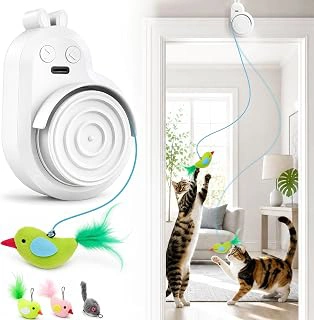
CATPICK Automatic Interactive Cat Toy with Flying Feather Bird & Mouse
The CATPICK Automatic Interactive Cat Toy delivers two rotating attachments - a feather bird and a mouse - designed to move unpredictably across a compact circular base. The unit's small footprint fits tight corners and under furniture in studio or one-bedroom layouts without blocking walkways. Its motion sensor detects movement within approximately three feet, triggering a multiple-minute play cycle that alternates speed and direction to hold your cat's attention while you work or sleep.
Noise output remains noticeably quieter than ceiling fans or kitchen appliances, making it suitable for open-plan apartments where sound carries between rooms. The motor hums softly during operation but stays below the ambient noise of HVAC systems or street traffic typical in mid-to-high-rise buildings. Cats accustomed to sudden sounds from neighbors or elevators adapt quickly to the toy's consistent mechanical rhythm.
Both attachments clip onto a rotating arm via snap-fit connectors, allowing you to swap the feather for the mouse in seconds without tools. The feather's fabric holds up to moderate biting and clawing for several weeks of daily use, while the felt mouse body shows wear faster under aggressive play. Replacement parts are not included, so budget for eventual re-orders if your cat favors one attachment heavily.
Battery operation (three AA, not included) reduces cords that cats might chew, but expect to replace cells every four to six weeks with regular use. The sensor's detection angle is fixed, so placement near your cat's preferred lounging spot improves engagement. If your apartment has multiple zones separated by walls, the toy won't trigger from adjacent rooms - a trade-off that helps reduce the chance of over-stimulation but limits coverage in larger floor plans.
Stability on hardwood or tile is adequate at low speeds, though high-speed rotation can inch the base forward during vigorous pouncing. A thin rubber pad underneath reduces sliding and muffles vibration transmitted through flooring, which matters if you share walls or floors with noise-sensitive neighbors. The toy's circular profile and neutral color blend into modern decor without standing out as pet equipment when not in use.
- ✅ Quiet motor stays below ambient apartment noise levels
- ✅ Compact circular base fits tight corners and under furniture
- ✅ Motion sensor triggers 15-minute play cycles automatically
- ✅ Tool-free attachment swaps between feather and mouse
- ✅ Battery-powered design eliminates chewable cords
- ⚠️ Felt mouse attachment wears faster than feather under aggressive play
- ⚠️ Battery replacement needed every four to six weeks with regular use
- ⚠️ High-speed rotation can inch base forward on smooth floors
- ⚠️ Fixed sensor angle limits coverage in multi-room layouts
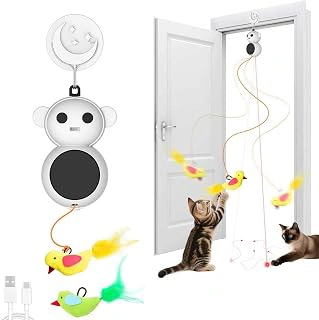
Catpick Automatic Laser Cat Toy with Flying Bird Feather Wand
The Catpick Automatic Laser Cat Toy with Flying Bird Feather Wand combines two interactive modes in one compact unit priced at $22.49. This dual-mode toy uses a motion sensor to activate either laser projection or a motorized feather wand, giving cats in smaller spaces variety without requiring multiple devices.
The motion sensor detects movement within a set radius and triggers the toy's active mode. The device does not run both laser and feather simultaneously; it operates in the mode you select via a switch on the unit. The laser projects random patterns across walls and floors, typically covering an area suitable for a single room or open-plan apartment zone. The feather wand rotates on a short arm, keeping the action contained to the toy's immediate footprint - useful when floor space is limited.
Noise output sits slightly above the rolling ball toys due to the motor that drives the feather mechanism. The whirring is steady but not jarring, though light sleepers may notice it through thin apartment walls if the toy activates at night. The laser uses a Class II diode, which is the same standard found in most consumer laser pointers. To reduce frustration, the pattern changes direction at irregular intervals rather than repeating a predictable loop, though some cats lose interest if they never catch the dot.
Laser safety depends on responsible use. The beam should not shine directly into a cat's eyes at close range for extended periods. Positioning the toy so the laser projects across horizontal surfaces rather than at eye level reduces risk. Ending each laser session by leading your cat to a physical toy they can capture helps prevent the dissatisfaction that can come from chasing an uncatchable target.
The feather wand mode offers a tangible reward, which some cats prefer. The wand's short arm means the feather stays close to the base, so cats that like wide chases may find it limiting. The toy's compact square design takes up minimal floor space, and the low profile makes it stable on hardwood or tile.
This pick works best for households that want two play styles in one device and can supervise laser sessions to ensure the cat gets a satisfying finish. If noise is a priority or your cat ignores lasers, the rolling ball option remains quieter and more tactile.
- ✅ Dual-mode design combines laser and feather wand in one compact unit
- ✅ Motion sensor activation keeps cats engaged without manual control
- ✅ Low-profile footprint fits tight apartment spaces
- ✅ Laser pattern changes direction to reduce predictability
- ✅ Affordable at $22.49 for two play types
- ⚠️ Motor noise is higher than rolling ball toys
- ⚠️ Laser mode requires supervision to avoid frustration
- ⚠️ Feather wand arm is short, limiting chase radius
- ⚠️ Does not run both modes simultaneously
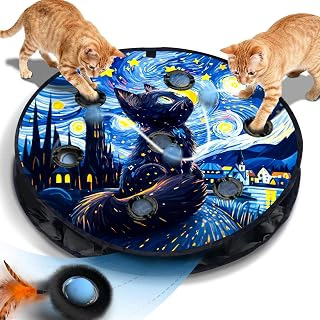
Interactive Cat Toy with Automatic Moving Ball and 7-Hole Maze Mat
The Interactive Cat Toy with Automatic Moving Ball and 7-Hole Maze Mat keeps the action contained within a rectangular mat, making it well-suited for apartments where a ball rolling under furniture would be a constant frustration. The ball travels beneath the mat surface and appears at random through seven openings, encouraging your cat to swat and pounce without the toy escaping across hardwood or tile floors.
Motion sensors wake the ball when your cat approaches, then pause after a period of inactivity to conserve battery. The mat itself measures smaller than many rotating feather toys, so it fits comfortably in narrower hallways or beside furniture without monopolizing floor space. Because the ball stays captured under the mat, noise remains minimal - no hard plastic collisions with Interactive Cat Toy with Automatic Moving Ball and 7-Hole Maze Mat or cabinet kicks at 3 a.m.
Mat material is smooth and lightweight, which means it can slide on polished floors if your cat attacks aggressively. Placing it on a rug or textured surface improves stability. Retrieving the ball for cleaning requires lifting the mat; the ball is not tethered, so it rolls free once exposed. If your cat prefers chasing objects in open space rather than pawing at fixed openings, the rotating feather or laser models will feel more dynamic.
At $24.98, this maze-mat design offers a contained play style that minimizes scatter and reduces the chance of losing pieces under appliances. Compare it to the rotating feather option if your cat responds better to aerial movement, or to the laser if you want a completely hands-off, zero-maintenance solution.
- ✅ Ball stays contained under mat, preventing scatter across apartment floors
- ✅ Motion sensor activation and auto-pause to save battery
- ✅ Compact rectangular footprint fits narrow spaces
- ✅ Low noise operation without hard collisions
- ⚠️ Mat can slide on smooth hardwood or tile without a rug underneath
- ⚠️ Ball must be retrieved manually by lifting the mat for cleaning
- ⚠️ Less engaging for cats that prefer chasing free-rolling or airborne targets
What to Consider When Choosing Automated Toys for High-Rise Living
- Noise level: motor hum, ball rolling, or feather flapping audible through walls or floors
- Footprint size: available floor space in living room, bedroom, or hallway
- Motion sensor range and sensitivity: does it trigger too often or miss a passing cat
- Power source: battery life versus plug-in convenience and cord management
- Attachment durability: feathers, mice, or balls that survive extended solo play
- Cleaning access: can you wipe down surfaces or replace worn parts without tools